
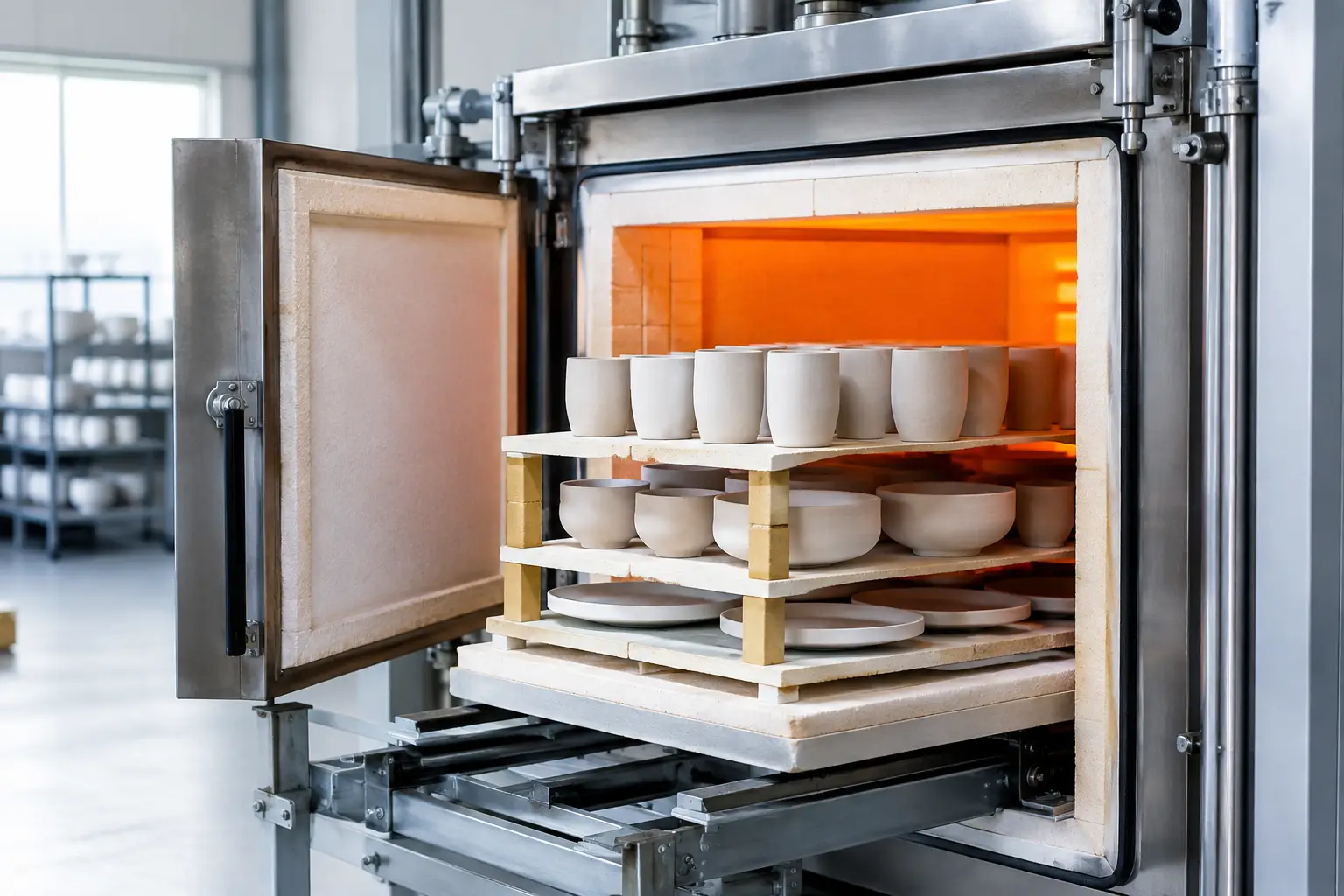
A ceramic component can be pressed to an impressive green geometry and still fail its real specification in the furnace. Thermal processing equipment for ceramics is where density, grain structure, shrinkage, surface condition and final dimensional capability are decided. For teams producing technical ceramics, hard materials or ceramic-based sensor components, the furnace is not simply the last station in the line. It is a controlled manufacturing process in its own right.
The right system must do more than reach a specified peak temperature. It must reproduce a temperature profile across the useful work zone, manage the required atmosphere, accommodate the product loading and support the level of traceability expected by the application. A laboratory result achieved on one carefully loaded batch is useful. A repeatable production result, across shifts and over years, is what turns a promising material into a dependable component.
What thermal processing must achieve
Ceramic thermal cycles commonly include drying, binder removal, calcining, sintering, firing, annealing or reaction bonding. Each stage changes the material, and each can introduce defects when the profile, atmosphere or load arrangement is poorly matched to the part.
During debinding, for example, organic binders must leave the component at a rate that avoids internal pressure and cracking. During sintering, particles bond and pores close, producing the density and mechanical properties required for service. At the same time, the part shrinks. Small differences in powder formulation, green density, setter contact, local temperature or gas flow can become measurable dimensional variation after firing.
That is why equipment selection starts with the process window, not a catalogue temperature rating. A furnace that reaches 1,700°C may be entirely unsuitable if its atmosphere quality, thermal uniformity, loading method or cooling behaviour does not fit the material system.
Thermal processing equipment for ceramics: key decisions
The first question is what the material needs to become. Alumina, zirconia, silicon nitride, silicon carbide, ferrites, piezoceramics and ceramic-metal composites each have different sensitivities. Some require oxidising conditions; others demand vacuum, inert gas, reducing gas or carefully controlled partial pressures. Certain processes rely on high-temperature hydrogen or nitrogen. Others need clean air firing with stable oxygen availability.
Temperature capability therefore matters, but the usable operating range matters more. Heating elements, insulation, retort materials and hearth design must remain compatible with the chosen atmosphere and process temperature. A design that performs well in air can have a short life in a reducing environment. Likewise, contamination from fixtures, setters or furnace linings can be unacceptable in electronic, medical or high-purity technical ceramic applications.
Uniformity is equally critical. The relevant figure is not only the controller setpoint but the actual temperature variation throughout the working zone under production load. A tightly controlled empty furnace can behave differently once shelves, saggers, setters and densely packed components affect radiation paths and gas circulation. Thermal mapping and representative load trials are essential before committing to production tolerances.
Cooling deserves the same attention as heating. Fast cooling can improve throughput, but it may create thermal gradients, residual stress or distortion. Slow cooling may protect fragile geometries, yet it lengthens the cycle and increases cost per part. The right approach depends on component shape, wall thickness, material thermal conductivity and the properties required after firing.
Batch or continuous production?
Batch furnaces offer flexibility. They suit product development, lower-volume specialist parts, varied firing cycles and work where a controlled load-by-load process record is valuable. They can also make sense where several component families share a facility but require different recipes.
Continuous furnaces are attractive where volumes are stable and high enough to justify dedicated flow. Belt, roller hearth, pusher and walking-beam designs can deliver consistent throughput and lower handling effort. Their challenge is that process changes take more planning. A continuous line rewards disciplined product design, stable powder and binder supply, consistent green-part quality and predictable demand.
Neither option is automatically better. A medical ceramic producer with frequent design changes may value batch flexibility more than theoretical capacity. A high-volume electronics manufacturer may need continuous processing to achieve the repeatability and unit economics required. The important point is to assess the whole production system, including loading, unloading, inspection and material handling, rather than selecting a furnace in isolation.
Atmosphere control is a component specification
Atmosphere is often treated as a furnace feature. In technical ceramics, it is part of the product specification. Oxygen level, moisture content, gas purity, dew point, pressure control and flow distribution can affect colour, electrical behaviour, phase formation, density and surface chemistry.
For parts used in sensors, semiconductors, energy systems or demanding mechanical assemblies, contamination control can be as important as temperature accuracy. Trace contaminants may alter dielectric performance, reduce insulation resistance or create unacceptable variation in metallised or joined assemblies. This is one reason why the furnace, gas delivery system, exhaust treatment and loading fixtures should be considered together.
Vacuum processing brings its own trade-offs. It can reduce oxidation and support clean, controlled conditions, but pump selection, leak integrity, outgassing behaviour and maintenance planning become central to reliable operation. Inert-gas systems require equally careful attention to gas quality and purge strategy. There is no benefit in specifying a high-purity process atmosphere if the chamber, seals or loading practice undermine it.
Designing for dimensional control after firing
Ceramic shrinkage is not a nuisance to correct afterwards. It must be understood and designed into the product from the first tooling discussion. A pressed or moulded green part may require carefully calculated oversize dimensions, but a single nominal shrinkage figure is rarely enough for tight-tolerance work.
Shrinkage can vary with powder batch, particle size distribution, binder content, compaction pressure, green density, firing position and peak-temperature exposure. Thin sections and thick sections may respond differently. Complex parts can warp because one region densifies or cools differently from another.
The most effective route is a closed technical loop between powder, forming method, thermal cycle, fixturing and final measurement. Process capability improves when each variable is treated as connected rather than assigned to separate suppliers or departments. For high-value parts, practical trials with production-representative tooling and loads are usually cheaper than discovering distortion after a major equipment investment.
Fixtures, setters and loading are not minor details
A well-designed furnace can still produce inconsistent components if the loading arrangement is an afterthought. Setters influence heat transfer, gas exposure, friction and support during shrinkage. Their material must withstand repeated cycles without reacting with the component or shedding contamination.
Loading density also affects cycle behaviour. Overloading may restrict gas movement and create cold areas. Underloading may make qualification trials unrepresentative of normal production. The best loading pattern balances capacity with uniform thermal exposure and gives operators a repeatable method that does not depend on individual judgement.
Data, maintenance and production confidence
Modern thermal systems should provide usable process evidence, not just a temperature chart. Recipe control, data logging, alarms, calibration records and batch traceability support both quality assurance and faster problem-solving. When a component drifts out of tolerance, teams need to compare real conditions between acceptable and suspect lots, including atmosphere readings, load configuration and actual cycle performance.
Maintenance planning should be part of the purchase decision. Heating elements age, thermocouples drift, insulation degrades and seals require inspection. In continuous equipment, wear components and transport mechanisms also influence uptime. A lower initial capital cost can become expensive if spares, service expertise or planned maintenance access are difficult to obtain.
This is where an experienced technical partner adds value. JVS helps customers connect process requirements with specialised thermal-processing capability, while keeping communication close to the engineering and purchasing teams in Germany and across Europe. The aim is not to force a standard machine into a complex application, but to define the equipment, process support and supplier relationship that make production dependable.
A better way to specify the system
Before requesting quotations, create a process brief that describes the component as well as the furnace. Include material composition, green-part dimensions, target density, tolerance requirements, annual volume, expected batch size, acceptable cycle time, atmosphere needs, contamination limits and required data records. Add likely future requirements too, such as additional materials, automation or higher throughput.
Then ask suppliers to respond against representative conditions. A quoted maximum temperature, chamber volume and headline power rating do not prove process suitability. Request evidence of temperature uniformity at the proposed operating range, atmosphere-control capability, fixture compatibility, maintenance requirements and support for commissioning trials. If possible, run sample parts through a realistic load configuration before finalising the specification.
The best thermal-processing investment is one that gives your team confidence when the material, geometry and production schedule become demanding. Start with the component’s real process window, test it under honest production conditions, and the equipment decision becomes far clearer.
