
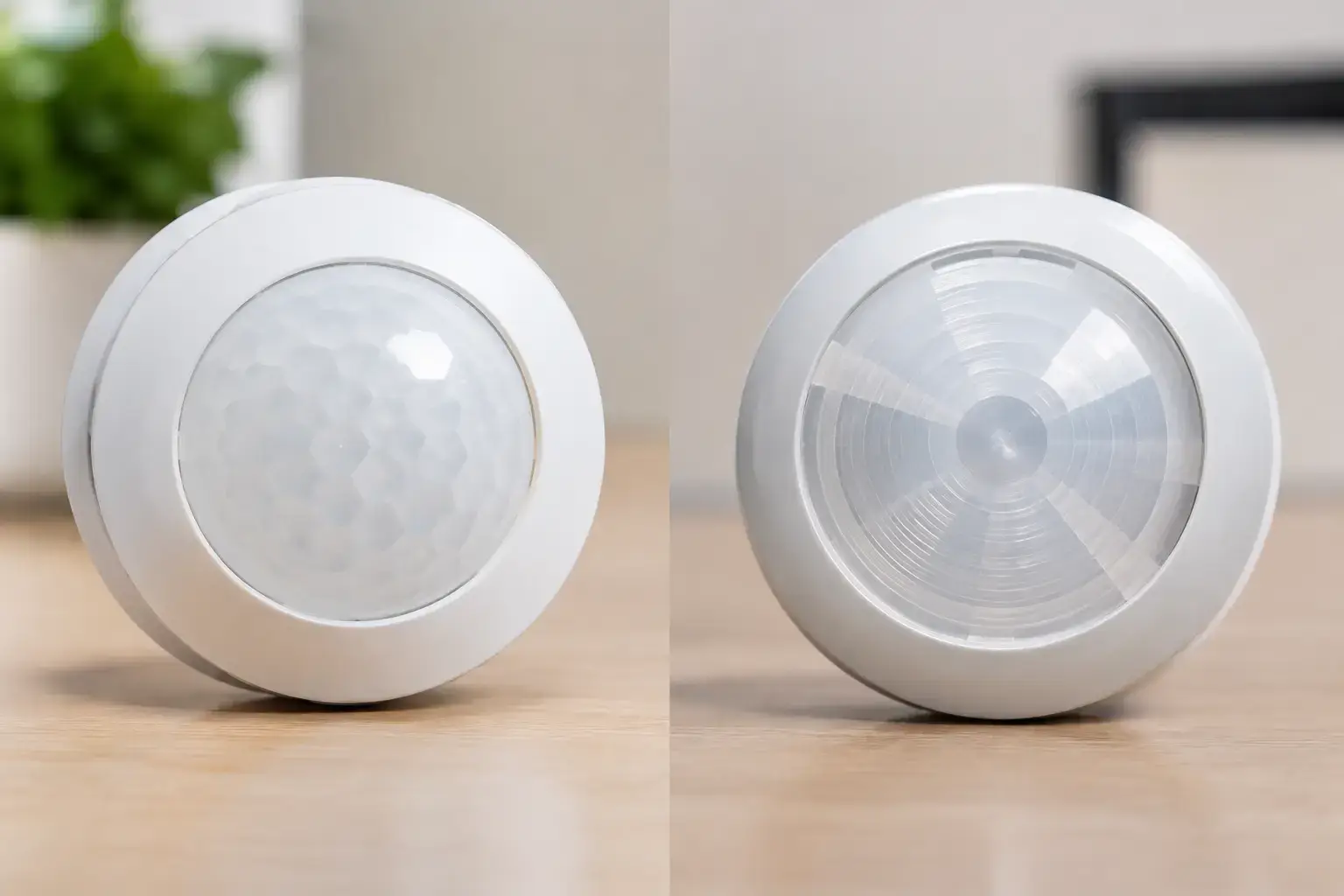
A motion sensor can have an excellent pyroelectric element, carefully designed electronics and a well-tuned algorithm, yet still deliver disappointing results if its optics are wrong. The discussion around PIR lens versus Fresnel lens often causes confusion because these terms do not always describe competing technologies. In many sensing products, a PIR lens is itself a specially designed Fresnel lens.
The useful question is not simply which lens is better. It is what the sensor must detect, across what area, at what mounting height, and with what tolerance for false triggers or missed events. For occupancy detection, people counting support, corridor lighting and security products, the optical design determines much of the real-world performance.
PIR lens versus Fresnel lens: application versus optical form
A PIR lens is an optic used with a passive infrared sensor. Its job is to collect infrared radiation emitted by people and other warm objects, then direct that energy onto the sensor element. Most PIR modules use a multi-segment lens that divides the monitored space into distinct detection zones.
A Fresnel lens is defined by its optical construction. Rather than using the thickness of a conventional curved lens, it uses concentric grooves or facets to bend and focus light or infrared energy. This approach creates a thin, lightweight and economical optic that can be moulded in high volumes.
That means the comparison needs a little care. A conventional Fresnel lens might be designed to concentrate light for illumination, projection or solar applications. A PIR Fresnel lens uses the same underlying principle, but its facets are arranged to create a field of view and a pattern of zones suitable for passive infrared detection.
Put simply: PIR describes the sensing application; Fresnel describes a lens architecture. A high-performance PIR lens will commonly be a Fresnel lens, but not every Fresnel lens is suitable for a PIR sensor.
Why PIR sensors need zones, not just focus
A PIR element does not measure a stable body temperature in the way a thermal camera does. It responds to changes in received infrared energy. This is why a person moving across the sensor’s field of view is usually detected more reliably than a person walking directly towards it.
A PIR Fresnel lens creates alternating positive and negative zones across the covered area. As a warm body moves from one zone to the next, the infrared energy reaching the sensor changes. The electronics can then identify the characteristic signal produced by movement.
This explains why lens selection directly affects detection quality. The lens governs the width and depth of each zone, their spacing, their vertical distribution and their overlap. It also influences blind areas, close-range behaviour and the sensor’s ability to distinguish useful movement from background changes.
For an office luminaire, the priority may be dependable coverage across desks and circulation areas. For a corridor, the optic must recognise movement along a long, narrow path. In a washroom or meeting room, minor body movement may matter more than long detection range. One generic lens geometry rarely provides the best result across all three cases.
The practical differences in a PIR optical design
When engineers compare a PIR-specific lens with a broadly specified Fresnel lens, four factors usually decide whether the finished product performs as intended.
- Infrared transmission: The material must transmit the wavelengths relevant to human-body radiation, typically in the long-wave infrared region. A lens that works well in visible light may be unsuitable for PIR sensing.
- Facet geometry: The number, size and orientation of Fresnel facets determine where energy is directed and how the detection zones are formed.
- Field-of-view pattern: A ceiling-mounted occupancy sensor may require 360-degree coverage, while a wall-mounted product may need a controlled 90-degree or 120-degree field.
- Sensor matching: The lens must be designed around the pyroelectric sensor, including its number of elements, element spacing, package position and aperture.
These variables interact. Increasing range may narrow zones or make close-in detection less effective. Broadening coverage may reduce received energy at the perimeter. Adding more zones can improve spatial definition, but it also increases the need for accurate mechanical alignment and stable manufacturing quality.
There is no universal optimum. The best lens is the one that produces sufficient signal-to-noise ratio for the actual installation, rather than the one with the most impressive range claim on a data sheet.
Material choice matters as much as lens shape
PIR Fresnel lenses are commonly moulded from polyethylene because it transmits long-wave infrared radiation effectively and can reproduce fine optical features. For volume products, this makes it a practical choice. The material, thickness, facet quality and tooling condition all contribute to optical consistency.
However, material selection is never purely an optical decision. Mechanical stiffness, temperature range, UV exposure, cosmetic requirements, assembly method and expected product life also need consideration. A lens used behind a decorative front cover has different constraints from one exposed on an outdoor security unit.
Surface texture and contamination deserve attention too. Dust, fingerprints, paint overspray and poorly controlled protective films can all attenuate or scatter the infrared energy that reaches the sensor. In production, a lens that is theoretically correct but difficult to handle consistently can become an avoidable source of yield loss and field complaints.
Conventional Fresnel optics are not automatically interchangeable
It is tempting to see a thin grooved lens and assume it can be adapted for PIR. Usually, that shortcut creates problems. Conventional Fresnel lenses are often designed around visible-light wavelengths, different focal characteristics or a single concentration point. PIR sensing requires an optical pattern that works with thermal radiation and produces controlled transitions across the sensor elements.
The mismatch can show up as poor range, irregular coverage, dead zones, excessive sensitivity at one angle or nuisance triggering from heat sources. A sensor may appear acceptable in a simple bench test and then behave unpredictably in a real room with windows, radiators, air movement and varying ambient temperatures.
For this reason, lens development should be treated as part of the sensing system, not as a late cosmetic component choice. The sensor, aperture, housing, PCB location, algorithm and intended installation geometry all belong in the same design conversation.
Selecting the right PIR lens for the installation
Start with the use case rather than a catalogue field-of-view figure. Define where the product will be mounted, how high it will sit, what direction people will move, and what detection event should switch or maintain the load. A people-presence application needs a different answer from a perimeter alarm.
Next, consider the environment. Large glazing areas, direct sunshine, HVAC outlets, machinery, pets and hot process equipment can all influence PIR behaviour. Optical zoning cannot solve every source of interference, but the right pattern can reduce unwanted sensitivity in known problem areas.
Mechanical tolerances deserve equal priority. Even a small shift between the lens and the sensor can alter the intended zone pattern. The housing must control lens position, sensor position and optical aperture repeatably over temperature and through assembly. In high-volume manufacturing, this is where an elegant optical concept either becomes a reliable product or a recurring quality issue.
Finally, validate in representative conditions. Test moving and near-stationary people, different approach angles, expected mounting heights and realistic ambient temperatures. A coverage diagram is a valuable design tool, but it is not a substitute for testing a production-representative assembly in the environment where it will operate.
When a custom lens is justified
A standard PIR Fresnel lens is often sensible for established applications with conventional mounting and coverage requirements. It can reduce development time and cost, particularly where the housing geometry is compatible and performance margins are comfortable.
A custom lens becomes more compelling when the product has an unusual form factor, demanding detection pattern, strict false-trigger requirement or a need to differentiate from existing products. It may also be the right route when the sensor must sit behind a constrained aperture or integrate with lighting optics and industrial design features.
The additional engineering effort should be assessed against the full project cost. Better detection can reduce commissioning issues, warranty exposure and redesign cycles. For product teams moving from concept to serial production, a technically fluent partner can help connect optical requirements with toolmaking, moulding and practical assembly control. That is the kind of project coordination JVS brings to specialist PIR lens solutions.
A well-chosen PIR lens does not merely make a sensor see further. It makes the product behave predictably where it matters: in the occupied room, along the corridor, beside the machine or at the entrance. Define that behaviour first, then let the Fresnel geometry earn its place in the design.
