
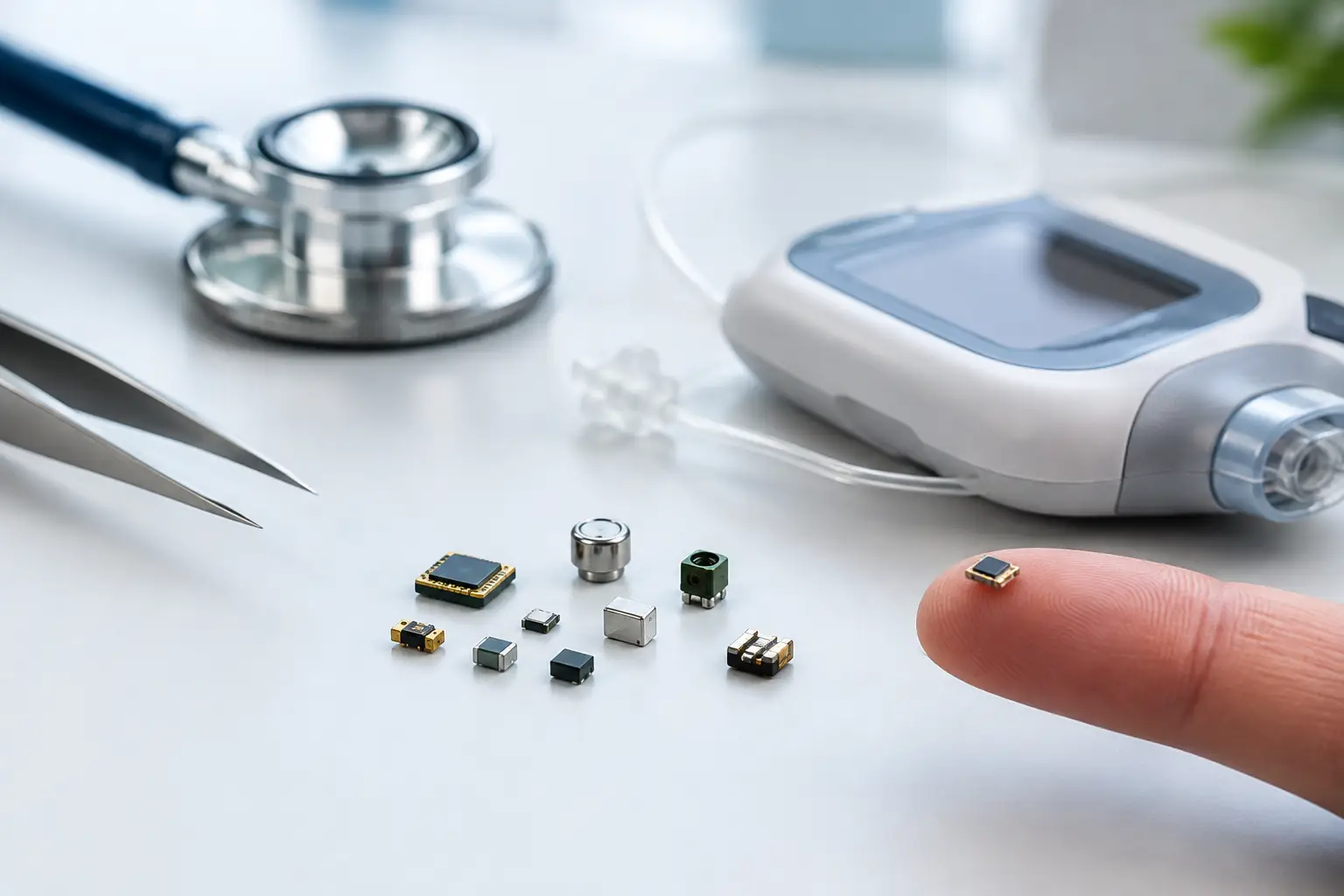
A device may be no larger than a pen cap, yet its reliability can depend on a formed metal tube, a tiny spring or a silicone seal measured in fractions of a millimetre. That is the real challenge with miniature components for medical devices: reducing size without reducing function, consistency or confidence in manufacture.
For development teams, miniaturisation is rarely a matter of simply scaling down an existing part. Wall thickness, grain structure, spring force, surface condition and assembly handling all change as dimensions shrink. A component that looks straightforward in CAD can become difficult to form, inspect, clean or assemble at volume. Small parts. Big solutions – but only when the production method is considered early enough.
Why miniature medical components need a different approach
In medical technology, a small component is usually carrying more responsibility than its size suggests. It may guide a catheter, retain a sensor, control fluid flow, protect electronics, transmit movement or create a barrier between materials. In each case, the part must perform repeatedly in a defined environment, whether that means exposure to body fluids, sterilisation cycles, mechanical loading, cleaning agents or long storage periods.
The design window can be unforgiving. A minor burr may damage a delicate assembly or interfere with insertion. A slight variation in spring force may alter actuation behaviour. An inconsistent coating can affect friction, corrosion resistance or electrical performance. Dimensional tolerances matter, but functional tolerances matter just as much.
This is why the best component decision is not always the one with the lowest piece price. It is the one that supports reliable function, realistic inspection, repeatable supply and efficient assembly. Those priorities must be balanced rather than treated as separate workstreams.
Start with function, not the manufacturing process
It is tempting to begin with a familiar process: machining for a metal part, moulding for an elastomer, or laser cutting for a flat profile. That can work, but it may also lock a team into unnecessary cost or avoidable technical compromises. A better starting point is to define what the part must do.
Ask how the component is loaded, what it contacts, how it is retained, which surfaces are critical and how it will be assembled. Also consider whether it is disposable or reusable, and whether it is part of a sterile barrier system or a non-patient-contact subassembly. These answers inform material selection, geometry and production route together.
A deep-drawn metal component, for example, can be an efficient choice for thin-walled cylindrical or cup-shaped geometries. Compared with machining, it can reduce material waste and support high-volume repeatability. However, draw ratios, corner radii and material condition must be designed around the forming process. A geometry that ignores these constraints may require extra operations, or may not be stable in production at all.
Similarly, a micro spring should be specified by its required force and deflection range, not only by wire diameter and outer diameter. The active coils, end configuration, stress level, material and tolerance stack all influence actual performance. At this scale, a drawing with every dimension tightly controlled can still leave too much uncertainty if the functional behaviour is not stated clearly.
Tolerances belong to the complete assembly
Tight tolerances are often necessary, but blanket tightness is not a quality strategy. It can increase cost, limit supplier options and create inspection burdens without improving the device. The useful question is: which dimensions control performance, and which merely describe the shape?
A tolerance analysis should include mating parts, assembly method and expected variation in downstream processes. If a tube is press-fitted into a polymer housing, the relevant issue is not simply tube diameter. It is the combined relationship between tube, housing, insertion force, material behaviour and temperature. This is where early supplier input can prevent a painful redesign later.
Materials and surfaces are part of the design
Medical-device requirements vary widely. A component in a surgical instrument has different needs from one in a wearable diagnostic device or a fluid-management system. Stainless steels, nickel alloys, titanium and precious-metal alloys may all be appropriate in the right context. The decision depends on mechanical properties, corrosion behaviour, conductivity, formability, joining requirements and the intended environment.
For elastomeric parts, silicone offers valuable options for seals, valves, overmoulded features and soft interfaces. Yet silicone formulation, hardness, geometry and mould design need careful alignment. Very thin sections or fine details may be technically feasible but sensitive to mould filling, demoulding and inspection. The answer is not always to make the feature larger. Sometimes a change in parting line, gate position or component architecture achieves the required result more reliably.
Surface condition deserves the same attention. A polished surface may reduce friction in one application, while a controlled texture may aid bonding or retention in another. Coatings can provide lubricity, insulation, wear resistance, corrosion protection or improved biocompatibility characteristics. They also add another process interface, so adhesion, thickness control and compatibility with cleaning or sterilisation must be evaluated as part of the component plan.
Choosing the right process for miniature components for medical devices
No single technology covers every miniature requirement. The most effective route often combines several specialised capabilities, with each selected for what it does best.
Deep drawing suits many thin-wall metal forms with a favourable length-to-diameter relationship. Precision metal-cut parts can produce intricate profiles and thin features where conventional stamping becomes restrictive. Wire forming and micro springs serve retention, actuation and contact functions. Micro silicone solutions support flexible sealing and fluid control. Precision machining remains valuable for complex features, prototypes and lower-volume components, although cycle time and material utilisation may make it less attractive for simple high-volume geometries.
The key is to compare processes against the full requirement, not only nominal geometry. Consider annual volume, acceptable tooling investment, material availability, secondary operations, measurement capability, cleanliness and pack-out requirements. A process that produces an excellent prototype may not be the process that gives stable output at scale.
Design for inspection, handling and assembly
If a critical feature cannot be measured economically and repeatably, it is not truly controlled. This becomes particularly relevant with internal diameters, very small radii, thin walls and delicate free-state parts. Inspection methods should be discussed before finalising the specification, including whether optical systems, contact measurement, vision inspection or functional gauges are appropriate.
Handling is another practical issue that drawings rarely communicate. Miniature springs can tangle. Fine wire forms can deform. Thin drawn parts can nest together. Soft silicone features can pick up particles or be damaged by unsuitable fixtures. Packaging and presentation are therefore engineering topics, not an afterthought for logistics.
Assembly can expose hidden weaknesses too. A part may meet its dimensional specification but fail when presented to automated equipment, orientated in a feeder or joined by laser welding, adhesive bonding or crimping. Development samples should be assessed in the intended assembly context wherever possible. The part is only successful when the device can be built consistently.
Bring specialist manufacturing into the conversation early
Medical-device programmes often involve a long chain of design, verification, validation and industrialisation activities. Late changes to a critical component can affect much more than the bill of materials. They can disrupt test plans, tooling schedules, supplier qualification and launch timing.
Early technical dialogue gives teams room to compare alternatives before decisions become expensive. It may reveal that a feature can be formed rather than machined, that a tolerance can be tied to a functional datum, or that two parts can be combined into one. It can also identify genuine risks that should not be designed away with optimistic assumptions.
This is where a technically fluent local contact can make a material difference. JVS Sales & Technical Consultants coordinates specialist manufacturers while staying close to the engineering conversation, helping customers move from an early sketch to a production-ready component without having to manage every niche process alone. The goal is practical: fewer surprises between concept, pilot builds and serial supply.
The small detail that decides whether a device feels dependable
Miniaturisation rewards precision, but it also rewards judgement. A component should be as small as the application requires, not smaller merely because it can be. Giving a spring one more active coil, a drawn feature a more generous radius or an assembly a clearer datum may make the difference between an impressive prototype and a dependable product.
When the next miniature part reaches the drawing board, bring the manufacturing conversation with it. The right question is not only, “Can this be made?” It is, “Can this be made repeatedly, inspected confidently and assembled without drama?” That is where ambitious medical-device ideas become components people can rely on.
