
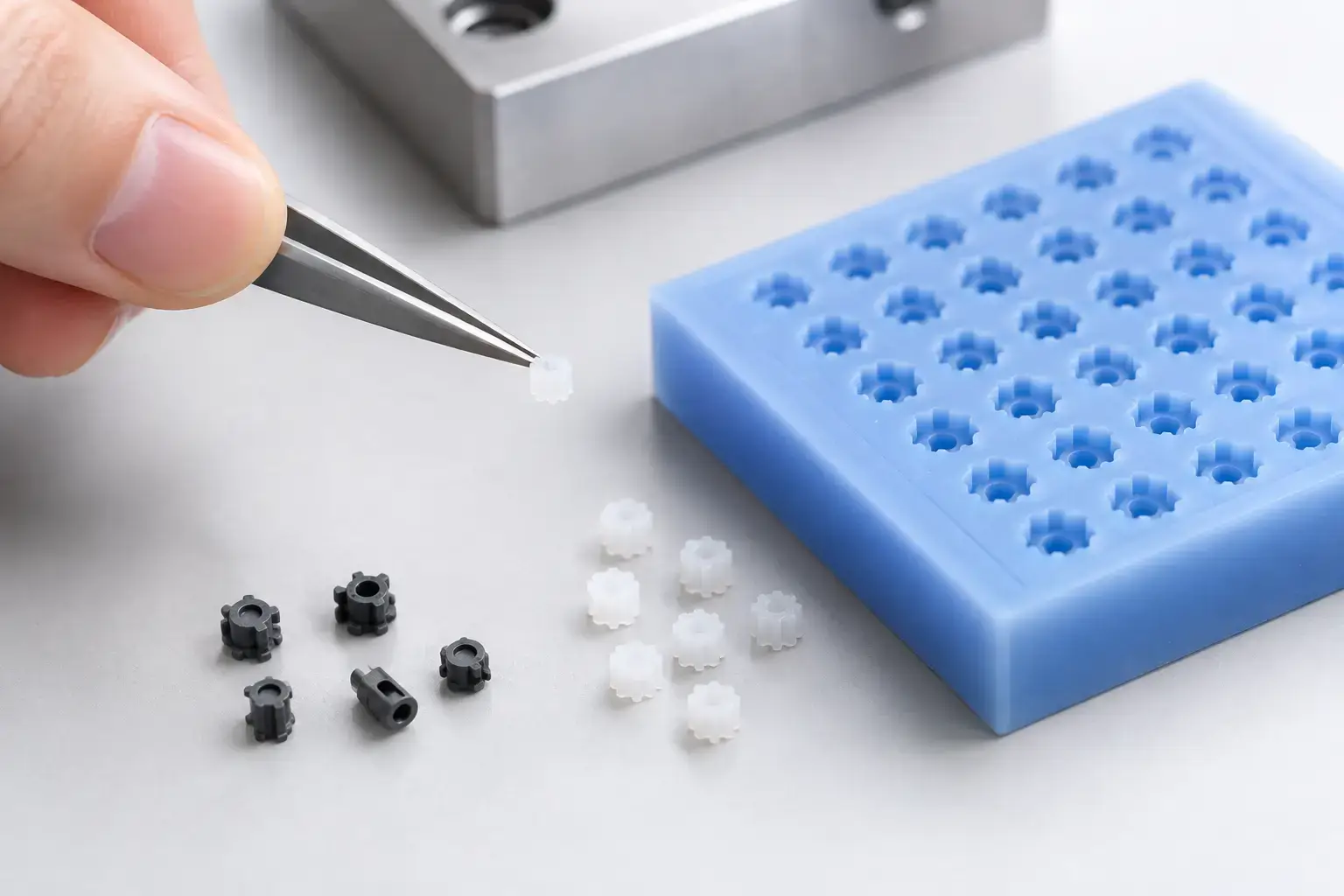
When a seal is smaller than a fingernail, a valve membrane must respond consistently, or an elastomer feature sits beside sensitive electronics, material choice alone will not carry the design. Micro silicone moulding services bring the tooling, process control and application knowledge needed to turn these very small, very demanding parts into reliable production components.
For medical technology, analytical instruments, sensor assemblies, fluid handling and compact industrial devices, silicone often solves problems that metals and rigid plastics cannot. It remains flexible across a broad temperature range, can offer strong chemical resistance and is well suited to soft sealing interfaces. Yet at micro scale, those benefits arrive with a stricter set of manufacturing questions: can the material fill the cavity? Will a delicate feature demould cleanly? How much variation is acceptable in the finished assembly?
Why micro silicone moulding is a different discipline
Micro moulding is not simply conventional moulding with a smaller tool. At miniature dimensions, details that may be secondary on a larger component become decisive. Gate position, venting, cure profile, material viscosity and part handling can each affect whether a feature is fully formed and dimensionally stable.
A thin silicone membrane may need to flex repeatedly without tearing. A micro gasket may need to seal against a mating surface with limited clamp force. A tiny overmoulded section may need to remain precisely located around a metal pin, sensor or moulded insert. In each case, the critical requirement is usually functional repeatability rather than a single impressive sample part.
That is why a productive discussion starts with the job the component must perform. Is it sealing gas, managing a liquid path, protecting an optical or electronic assembly, damping vibration or providing a soft-touch interface? The answer informs silicone grade, hardness, geometry, production method and inspection plan.
Start with the functional dimensions
Design teams understandably focus on nominal dimensions, especially where the assembly has very limited space. For a silicone component, however, the dimensions that matter most are often the ones that affect compression, deflection and contact pressure.
A lip seal, for example, may not need every external feature held to the same tolerance. Its sealing bead, mould parting line and the relationship between its internal diameter and the mating component are more likely to determine performance. Assigning tight tolerances across every surface can add tooling and inspection complexity without improving the result.
It also helps to define the measurement condition early. Silicone is compliant. A component can deform under handling or during measurement, and results may vary according to the fixture, probe force and temperature. Agreeing how key characteristics will be measured prevents a familiar late-stage problem: a part is accepted by one method and rejected by another.
Material selection is an application decision
Silicone is a family of materials rather than a single answer. Liquid silicone rubber is frequently selected for fine features and repeatable automated processing. High-consistency silicone rubber may suit other geometries or material requirements. The right choice depends on the component, production volume and performance environment.
Hardness is only one part of the picture. Engineers may also need to consider tear strength, compression set, thermal stability, chemical exposure, electrical properties, colour, translucency and biocompatibility requirements. A soft material can improve conformity against an uneven surface, but it may be harder to handle and inspect. A firmer grade may provide better dimensional control, but require more force in the final assembly.
Where medical, laboratory or food-contact applications are involved, traceability, cleanliness and the applicable material documentation should be addressed at the specification stage. It is much easier to build the correct controls into the project than to retrofit them after validation has begun.
Tooling determines what is practical
The mould tool translates a CAD model into a physical part, but it also controls how consistently that part can be produced. For micro silicone moulding, the tool must account for material flow, air evacuation, curing, shrinkage, parting-line location and safe removal of the finished component.
Very fine ribs, long thin sections and enclosed geometries can be possible, but they need an honest manufacturability review. A feature that looks straightforward in CAD may create a filling risk, trap air or leave too little material at the parting line. Sometimes a small geometry change – a revised radius, a more generous draft angle or a relocated gate – can materially improve production capability.
Tooling choices also depend on expected demand. Prototype tools can support early functional testing and design refinement. For sustained production, hardened tooling and automation may be justified to maintain cycle consistency, reduce manual handling and support higher output. There is no universal threshold. The right route depends on part complexity, quality requirements and the cost of a supply interruption.
Overmoulding and insert moulding need early planning
Many miniature silicone parts do not exist on their own. They are moulded around pins, sleeves, contacts, filters or small metal components, or joined to a plastic substrate. These hybrid designs can reduce assembly steps and improve sealing performance, but they require careful consideration of material compatibility and component location.
An insert must be accurately positioned and retained during moulding. The silicone must flow around it without shifting it or creating voids. If bonding is required, the relevant surfaces may need preparation, a primer system or a mechanical retention feature. A bond should never be assumed simply because two materials are moulded together.
For assemblies containing electronics or sensing elements, temperature exposure and contamination control deserve particular attention. The silicone cure process must fit the limitations of the insert, while any flash, volatiles or residue must be managed according to the application. In sensor and optical products, a minute amount of unwanted material in the wrong place can have a disproportionately large effect.
Define quality around real risks
A sensible quality plan reflects the failures that matter in use. For a micro valve, that may mean opening pressure, flow behaviour and membrane integrity. For a sealing part, it may include leak testing, compression performance and visual control of critical edges. For an overmoulded component, insert position and bond integrity may be the defining characteristics.
Dimensional inspection remains essential, but micro components often benefit from a combination of methods. Optical measurement can capture fine geometry without contact. Purpose-built gauges can verify functional interfaces quickly. Vision systems can identify flash, short shots or contamination where manual inspection would be inconsistent. Sampling levels should be proportionate to the process maturity and the consequence of failure.
This is also where a supplier’s production experience matters. A design that is technically mouldable once is not automatically suitable for a stable, economical process. Process windows, material lot control, validated handling and clear acceptance criteria all contribute to repeatable supply.
A better route from concept to production
The most effective micro silicone projects bring the moulding specialist into the conversation before the design is frozen. Share the available CAD data, key dimensions, annual demand, mating parts, operating environment and the failure modes the component must avoid. A good technical review can then distinguish between what is theoretically possible and what is sensible to manufacture at scale.
At JVS Sales & Technical Consultants GmbH, the role is to make that discussion practical: connecting development and purchasing teams with specialist micro-component capability while keeping technical communication close to the customer. That means coordinating the route from an early sketch through material and tooling decisions to production-ready supply, rather than leaving teams to translate requirements between multiple niche partners.
Small parts can carry a great deal of responsibility. Give the micro silicone component a specification based on function, not just dimensions, and it has a far better chance of doing its quiet but critical job for the life of the product.
