
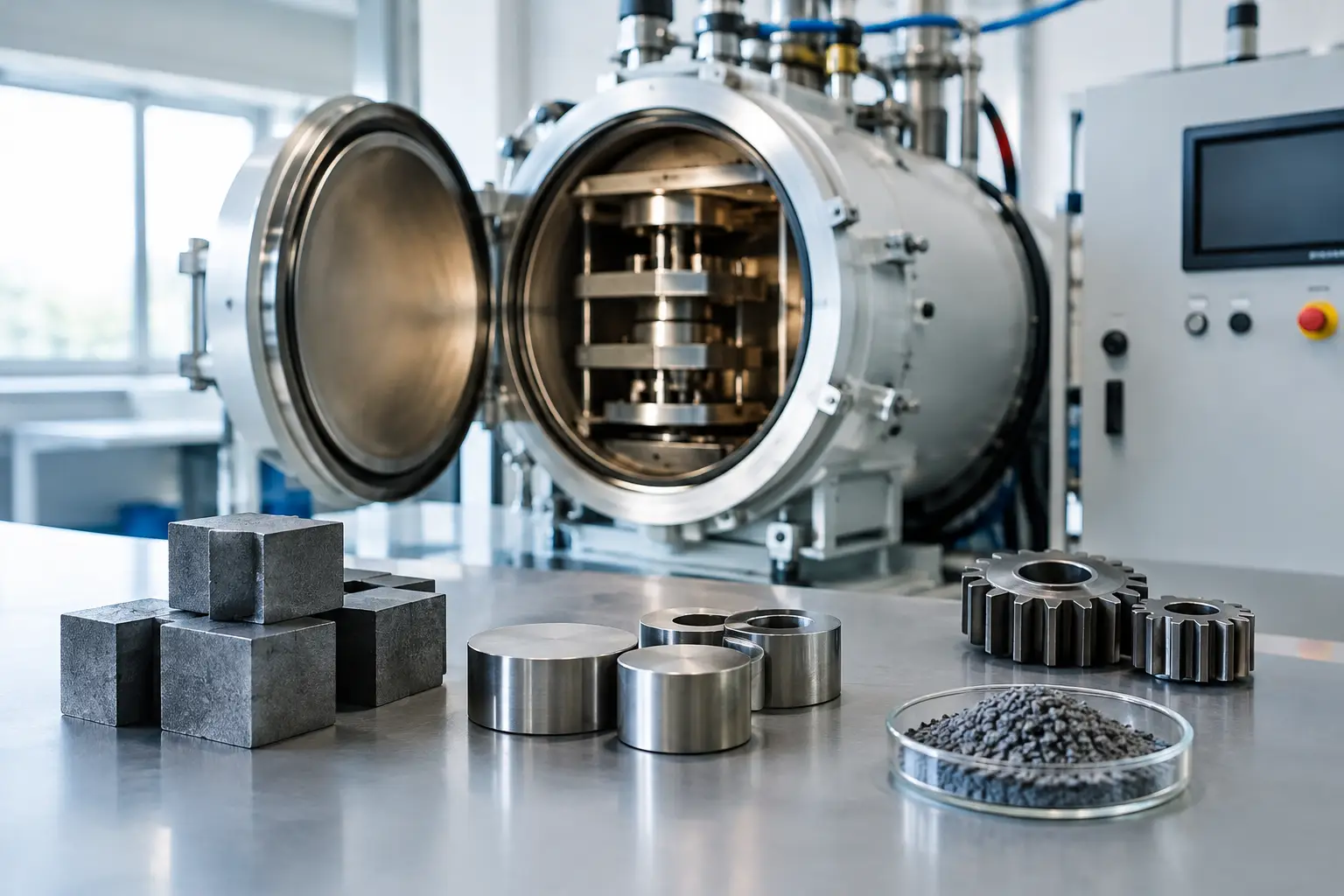
A hard-metal component can look perfect after pressing and still fail its final specification in the furnace. Density gradients, cobalt pooling, distorted edges, unexpected carbon balance and inconsistent shrinkage are usually not solved by simply increasing the peak temperature. They are signs that the complete thermal cycle, atmosphere and handling concept need closer attention. Selecting sintering equipment for hard metals is therefore a process decision, not just a capital-equipment purchase.
For manufacturers of cemented carbide tools, wear parts, dies and precision components, the furnace must produce repeatable microstructure and dimensional behaviour across every qualified batch. That calls for a clear understanding of the material system, production volume and downstream requirements before comparing furnace brochures.
Start with the hard-metal process window
Most hard metals are cemented carbides: typically tungsten carbide combined with a cobalt, nickel or mixed-metal binder. During liquid-phase sintering, the binder phase melts and assists densification while the carbide skeleton develops its final structure. A small deviation in carbon potential, temperature uniformity or dwell time can affect porosity, grain growth, binder distribution and mechanical properties.
This is why nominal maximum temperature is a poor starting point on its own. A furnace capable of reaching the required setpoint may still be unsuitable if it cannot hold the part load uniformly, remove binder residues effectively or manage pressure reliably during the critical stages of the cycle.
The right specification begins with the powder grade and component geometry. Fine-grain carbide for a micro-drill presents different risks from a large mining insert or a complex wear component with varying wall thicknesses. The former may be particularly sensitive to grain growth and shape change; the latter may require careful support design and longer thermal equalisation. It depends on the material, the green density, the tolerances and what the part must do in service.
What sintering equipment for hard metals must control
A well-specified system controls far more than heat. The key is to consider the full route from compact to finished part, including debinding, pre-sintering, final sintering, cooling and, where required, hot isostatic pressing.
Temperature uniformity and measurement
Hard-metal sintering commonly operates in the region of 1,350°C to 1,550°C, depending on the grade and binder system. At these temperatures, meaningful uniformity is not a minor detail. Different positions in the hot zone can produce different shrinkage, density and grain structure if the load is not exposed to the same thermal history.
Ask how uniformity is demonstrated at your intended operating range, with a representative load rather than an empty chamber. Review thermocouple placement, control zones, calibration practice and data recording. For high-value precision parts, the evidence behind the stated uniformity matters as much as the stated figure.
Heating and cooling rates also deserve attention. Faster cycles can improve throughput, but aggressive ramps may increase thermal stress or make it harder to evacuate volatile species from dense loads. Controlled cooling can influence binder-phase distribution and reduce risks associated with thermal shock. The best programme is rarely the fastest available programme.
Vacuum quality, atmosphere and carbon control
Vacuum sintering is widely used for hard metals because it supports clean processing and effective removal of contaminants. However, vacuum level alone does not define furnace performance. Leak integrity, pumping configuration, chamber cleanliness, gas purity and the way gases move through the load all affect results.
Carbon control is particularly demanding. A carbon-deficient alloy can form eta phase, which is hard and brittle. Excess carbon can lead to free graphite. Both conditions can compromise performance, and both may originate from variables outside the powder formulation, including lubricant removal, furnace condition, graphite fixtures and atmosphere management.
Hydrogen may be used in certain process stages, especially for reduction and debinding, but it brings additional infrastructure and safety requirements. Nitrogen or argon may be used for backfilling, pressure control and cooling. The correct gas strategy should be designed around the chemistry of the grade and the site’s operating capability, not copied from a different product family.
Pressure capability and sinter-HIP
Residual porosity is a concern where hard-metal parts face high contact loads, fatigue conditions or demanding wear environments. Sinter-HIP combines liquid-phase sintering with gas pressure, commonly argon, to close pores and improve density. It can be a strong choice for high-performance cutting tools, tooling components and critical wear parts.
The trade-off is investment, cycle complexity and maintenance. Not every component needs sinter-HIP, and using it indiscriminately can add cost without solving the actual cause of variation. If conventional vacuum sintering already produces the required density and consistency, a simpler configuration may be more commercially sensible. Conversely, when the specification permits little tolerance for porosity, pressure capability should be considered at the beginning rather than added after qualification problems emerge.
Load design and handling
Fixtures are part of the process. Graphite trays, setters, supports and spacers influence heat transfer, gas flow, contamination risk and deformation. Their mass can also extend heating and cooling times considerably. A furnace selected solely on chamber volume may disappoint if the usable load arrangement is inefficient.
Consider the maximum load mass, part presentation, stacking height and the number of product references likely to run through the system. Small, high-value precision parts may benefit from tailored carriers that protect geometry and provide repeatable positioning. Larger batches may call for a loading concept that balances capacity with uniform exposure.
Automation is equally relevant. Manual loading can be practical during development or low-volume production. At higher volumes, controlled transfer, recipe management and traceable batch handling reduce variation and operator dependency. The appropriate level of automation should reflect actual production needs, not a desire to automate every visible step.
Match the furnace architecture to production reality
Batch furnaces offer flexibility for mixed product portfolios, development work and frequent recipe changes. They allow teams to qualify new grades without committing an entire line to one cycle. For many specialist hard-metal producers, that flexibility is valuable.
Continuous systems can be attractive for stable, high-volume programmes. They may offer efficient material flow and consistent cycle conditions once established, but they demand disciplined loading, product standardisation and predictable demand. A continuous line can be highly productive, yet it is less forgiving when a new component requires a substantially different thermal profile.
The decision should also account for upstream and downstream constraints. Is powder compaction stable enough to take advantage of higher furnace throughput? Can grinding, coating or inspection keep pace? Is there enough capacity for maintenance, qualification runs and unexpected rework? A sintering furnace should remove a genuine production constraint rather than move it to the next department.
Specify data, service and maintainability early
Hard-metal sintering is a controlled manufacturing process, so the system must provide usable process evidence. Recipe access, batch records, alarm histories, pressure curves, vacuum trends and temperature data support root-cause analysis when results drift. For regulated or safety-critical applications, traceability requirements may be even more detailed.
Serviceability deserves the same practical scrutiny. Graphite heating elements, insulation, pumps, seals and gas-control components all have finite service lives. Ask about access for routine maintenance, recommended spare parts, remote diagnostics, response times and training for local teams. A technically advanced furnace is of limited value if a routine repair stops production for weeks.
This is where a technically fluent project partner can add real value. JVS Sales & Technical Consultants helps teams connect equipment decisions with powder compaction, thermal processing and the practical realities of component production. The useful conversation is not simply, “Which furnace should we buy?” It is, “What process capability must this line deliver, and how will we prove it?”
A better way to evaluate suppliers
Before requesting quotations, create a process specification that describes more than chamber dimensions and peak temperature. Include the hard-metal grades, green-part dimensions, target density, expected shrinkage, surface requirements, acceptable porosity, batch size, annual volume and required traceability. Identify the most difficult component, not only the easiest one.
Then ask suppliers to explain how their proposed design manages your risks. Request representative cycle data where available, clarify acceptance testing and agree what constitutes successful commissioning. If a trial is possible, use production-intent powder, fixtures and loading patterns. A beautifully sintered sample made under laboratory conditions is encouraging, but it is not yet proof of a capable manufacturing process.
The furnace should give your team a stable platform for learning as well as production. When the material, compaction and thermal cycle are treated as one connected system, hard-metal sintering becomes far more predictable – and ambitious component designs become much easier to turn into dependable production parts.
