
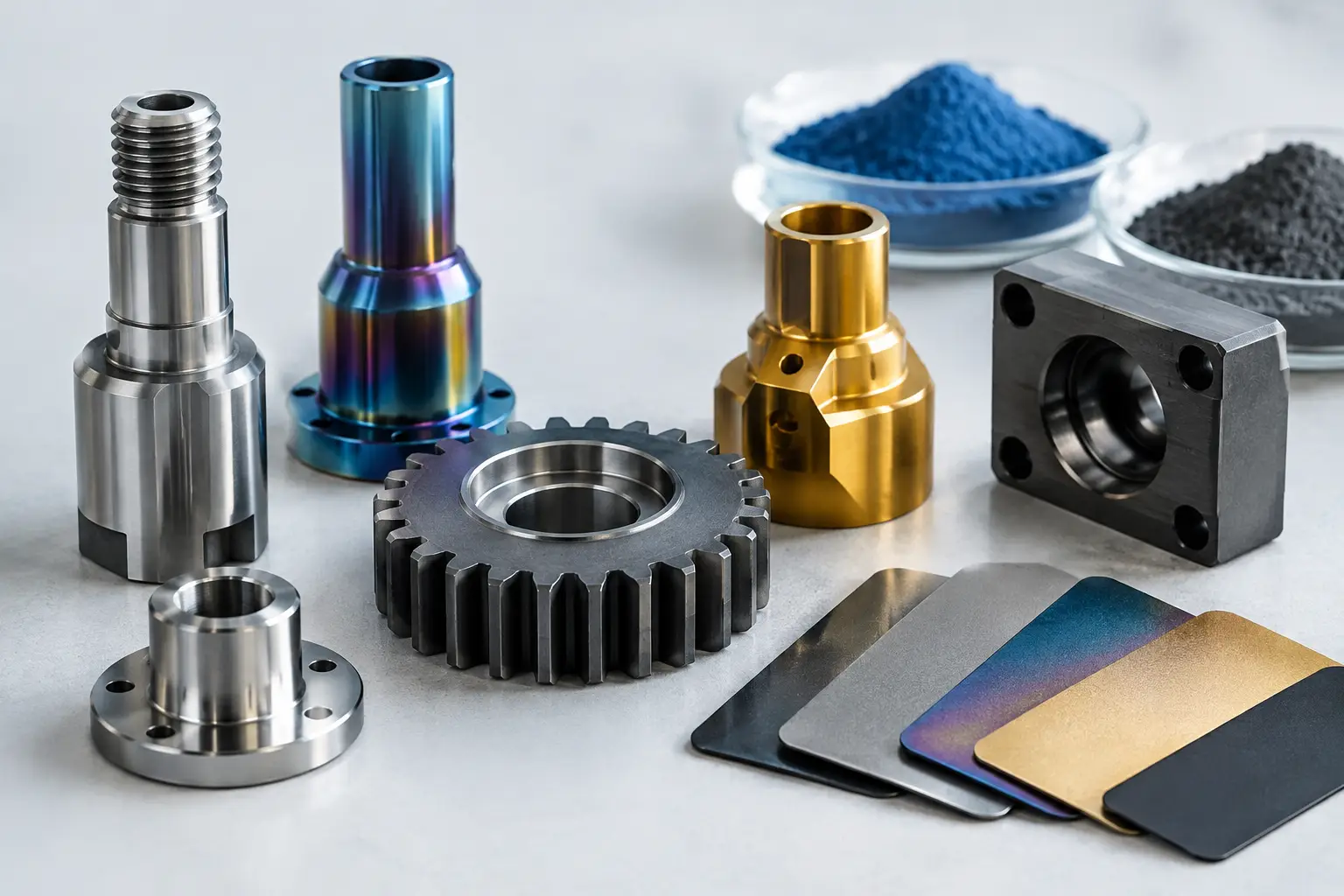
A coating measured in microns can decide whether a precision component slides smoothly, survives a salt-spray test, holds a reliable electrical contact or fails at final assembly. Surface coatings for precision parts are therefore not a finishing detail to add after the drawing is complete. They are part of the component design, with direct consequences for geometry, material selection, process route, cost and supply reliability.
For miniature deep-drawn components, micro springs, stamped contacts and machined parts, the question is rarely simply which coating is best. The useful question is which surface condition delivers the required function without compromising the tightest tolerances or the manufacturability of the part.
What surface coatings for precision parts must achieve
A coating may be specified for corrosion resistance, wear reduction, electrical conductivity, solderability, biocompatibility, optical behaviour or controlled friction. In demanding applications, it often needs to perform several of these jobs at once. A medical device component may require cleanability and corrosion resistance. A sensor contact may need stable conductivity after thermal cycling. A small spring in an automotive assembly may need protection from humidity while preserving its fatigue performance.
The complication is that the coating changes the surface. Even a thin deposit can alter a critical diameter, a sealing face, a press fit or the force required to assemble two parts. On a component with a 0.05 mm tolerance, treating coating thickness as an afterthought is an expensive way to create a problem.
Surface preparation matters just as much as the coating itself. Oils from forming, machining residues, oxides, burrs and surface roughness can affect adhesion and consistency. A good specification defines the substrate, pre-treatment, coating system, thickness range and inspection method together. Specifying only a material name is often too vague for production.
Start with function, not a coating name
Engineers often begin with a familiar finish: zinc for corrosion protection, nickel for a barrier layer, gold for contact performance, or a PVD coating for wear. That can be a sensible starting point, but it can also narrow the discussion too early.
First establish what the part experiences in service. Consider the base material, operating temperature, humidity, chemicals, mating material, electrical current, expected cycles and lifetime. Then identify the surfaces that are functionally critical. A whole-part coating may be unnecessary if only a contact area, bore or sliding interface needs a particular performance level.
This approach also exposes conflicts early. A thicker coating may improve corrosion life yet close up a fine feature. A hard coating may improve wear resistance but introduce a rougher surface than a delicate seal can tolerate. A highly conductive finish may be unsuitable for high-wear sliding. There is no universal hierarchy of coatings – performance depends on the application and the complete stack of substrate, preparation, process and environment.
Corrosion protection
Zinc-based and zinc-nickel systems are widely used where steel components need economical protection in automotive, industrial and general mechanical applications. Conversion layers and sealers can further improve performance, though they may affect friction, appearance or electrical contact behaviour.
Nickel coatings can provide corrosion resistance and a useful barrier layer, particularly where subsequent precious-metal plating is required. Electroless nickel is valued for its relatively uniform thickness on complex geometries, but the phosphorous content, heat treatment and environmental exposure all influence the result. The right choice depends on the component shape and the actual corrosion mechanism, not only on the number of hours stated in a test requirement.
Wear and friction control
For moving precision parts, hard chrome alternatives, electroless nickel, PVD coatings, DLC and specialised dry-film systems may be considered. Their benefits vary considerably. DLC, for example, can deliver low friction and excellent wear behaviour in the right contact conditions, but coating adhesion, edge geometry, counterface material and lubrication cannot be ignored.
A coating that performs well on a flat test coupon may behave differently on a tightly wound spring or a thin deep-drawn cup. Sharp edges, high residual stress and severe deformation zones deserve special attention. In some cases, improving the base material finish or adjusting the forming route is more effective than applying a more sophisticated coating afterwards.
Electrical and solderable surfaces
Tin, silver, nickel, gold and other functional plating systems are commonly used in connectors, sensor elements and electronic assemblies. Thickness, porosity and underplate selection affect contact resistance and long-term stability. Gold is highly effective for low-level signal contacts, but it is not automatically the right answer for every electrically active part. Cost, wear, mating cycles and the risk of fretting corrosion need to be evaluated together.
For solderable components, storage conditions and the assembly process matter. A finish that solders reliably after plating may not behave the same way after months in storage, thermal exposure or handling. This is where realistic validation beats a paper-only specification.
Tolerance is a coating requirement
Precision parts are designed around dimensions, but coating thickness is often specified as a broad range without linking it to the part’s functional features. That is risky. A 5 µm deposit on each side of a diameter reduces an internal feature by approximately 10 µm. On a micro-scale part, that can consume a meaningful proportion of the available tolerance.
Specify which dimensions apply before coating, after coating or both. Internal diameters, threads, small holes, press-fit zones and sealing interfaces are particularly sensitive. Masking may protect selected surfaces, but it adds handling, cost and process variation. It is worth assessing whether the feature can be redesigned, whether a selective process is appropriate, or whether the coating thickness can be controlled more tightly.
Coating distribution also matters. Electroplating tends to build more heavily on edges and external features, while recesses may receive less deposit. Geometry, racking, current density and shielding affect the outcome. Electroless processes can offer better uniformity, but may bring their own constraints on material compatibility, cost and achievable properties.
The drawing should make the intent unambiguous. State the coating system, thickness at the relevant measurement location, permitted variation, areas to be coated or excluded, post-treatment and any functional test requirements. Where appearance matters, define an agreed standard rather than relying on terms such as bright or uniform.
Select a process that respects the component
A technically suitable finish can still be the wrong production choice if it damages delicate parts, slows handling or cannot be inspected consistently. Micro springs may tangle during bulk processing. Thin-walled formed parts can deform under unsuitable fixturing. Small bores can trap process fluids. Components with critical cosmetic faces need racking strategies that avoid contact marks in visible areas.
Hydrogen embrittlement is a central consideration for high-strength steels after cleaning and electroplating. The risk must be addressed through material selection, process control and, where appropriate, prompt de-embrittlement baking. It should never be left as a generic note at the bottom of a drawing. The consequences may only appear later as delayed cracking or unexpected fatigue failures.
Environmental and regulatory requirements also shape the decision. Restrictions on hexavalent chromium, application-specific requirements for medical technology and aerospace, and customer chemical declarations can rule out otherwise familiar options. Bringing these constraints into the discussion before sampling prevents late-stage rework.
Validate on production-representative parts
Sample approval should test the part as it will be used, not merely prove that coating exists. Thickness measurement, adhesion checks, visual inspection and corrosion testing are useful foundations. Depending on the application, teams may also need contact-resistance measurement, solderability testing, friction testing, wear cycling, chemical exposure, thermal cycling or fatigue assessment.
The sample route should represent the intended production method. A hand-racked prototype and a high-volume barrel process can produce different coating distributions, handling marks and cosmetic results. Where a component is safety-critical or performance-critical, establish acceptance criteria and a control plan before ramp-up rather than negotiating them after the first delivery.
At JVS, the practical value of a specialist network is not simply access to coating capability. It is the ability to coordinate coating decisions with the manufacturer of the deep-drawn part, spring, wire form or machined component, so that material, geometry, tolerances and finishing route are considered as one production system.
Questions worth resolving before release
Before a coated precision part moves from concept to serial production, the project team should be able to answer a few direct questions. What function does the coating provide? Which surfaces are critical? Are dimensions specified before or after coating? How will thickness be measured on the actual geometry? What preparation and post-treatment are required? And which test best represents service conditions?
Those answers are not paperwork for paperwork’s sake. They turn a finish from a purchasing line item into an engineered feature with a defined purpose. When the component, coating supplier and product team align early, even very small parts can deliver the large-scale reliability the finished product depends on.
