
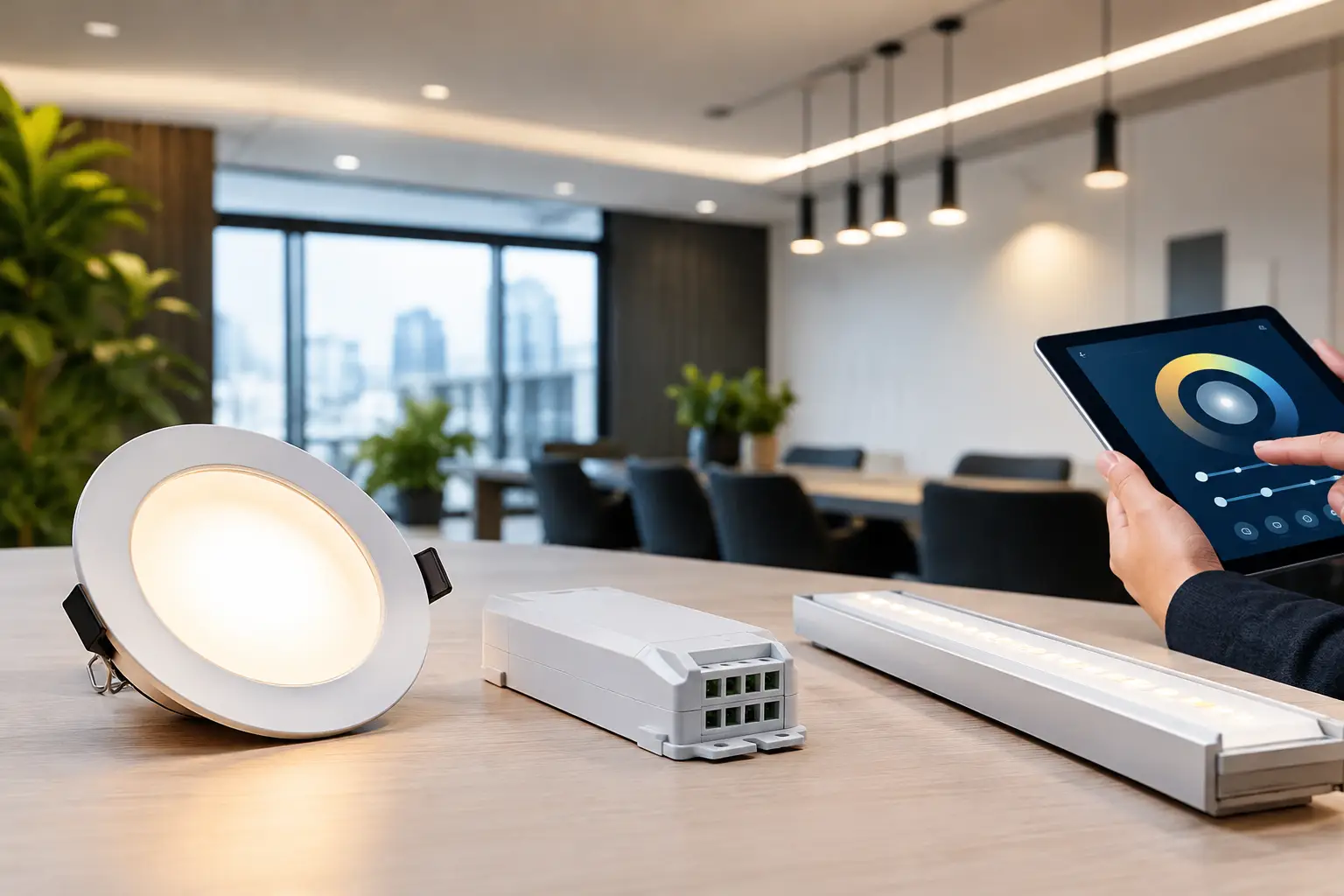
A luminaire can have excellent optics, thermal management and LED efficacy, then lose much of its value through an inflexible control arrangement. In projects where lighting must adapt to occupancy, daylight, operating hours or changing room layouts, DALI LED modules provide the intelligent connection between the luminaire and the building control strategy.
For product developers and lighting manufacturers, the question is not simply whether a luminaire can dim. The real question is whether it can deliver repeatable light output, reliable communication and practical commissioning throughout its working life. That requires selecting the right combination of LED module, driver and DALI interface early in the design process.
What DALI LED modules actually do
DALI stands for Digital Addressable Lighting Interface. It is a two-wire digital protocol used to control luminaires and associated devices individually or in groups. Unlike a simple switched circuit or analogue 1-10 V arrangement, DALI communication is addressable and bidirectional. The control system can issue commands, while compatible devices can report information such as status, faults and operating data.
The term DALI LED module is used in more than one way. It may refer to a smart LED light engine with DALI-compatible electronics, or to the LED module and DALI driver combination specified as a functional lighting assembly. In most cases, DALI does not control the LED board directly. It communicates with the LED driver, which regulates current to the LEDs.
That distinction matters. An LED module determines luminous flux, colour quality, beam behaviour and thermal requirements. The driver determines dimming performance, electrical protection and communication behaviour. Treating them as separate items rather than a proven system can create avoidable compatibility work later.
Why addressability changes the luminaire proposition
A DALI-controlled luminaire can be assigned an individual address, added to one or several groups and programmed with scenes. This allows a manufacturer to offer a common hardware platform that is configured differently for a corridor, office, educational space, retail environment or industrial facility.
For end users, this supports energy reduction without compromising useful illumination. A meeting room can hold a defined scene for presentation use, then return to daylight-responsive operation. A circulation area can dim during quiet periods while maintaining a safe background level. In industrial settings, lighting can be matched more closely to operating shifts and task zones.
The value is not limited to energy savings. Addressability makes maintenance more informed. Where the wider system supports it, facility teams can identify failed luminaires or driver faults without relying solely on visual inspections. For projects with hundreds or thousands of light points, that is a meaningful operational benefit.
Specify the system, not just the interface
Seeing “DALI compatible” on a data sheet is a starting point, not a complete specification. A reliable result depends on how the LED module, driver, control devices and luminaire mechanics behave together.
Match current, voltage and thermal conditions
The LED module’s forward voltage range and rated current must fit the driver’s output range across the expected operating temperature. This sounds straightforward, but tolerance stacks matter. LED electrical characteristics shift with junction temperature, and a luminaire’s thermal design affects both performance and lifetime.
A driver operating close to its minimum or maximum limits may work on the bench yet be a poor choice for sustained production. Leave appropriate headroom, verify performance in the finished housing and assess the thermal path from the LED board to the heat sink. High efficacy is useful, but stable efficacy over the specified lifetime is more useful.
Define dimming expectations properly
Not all dimming requirements are alike. A warehouse high-bay fitting may only need dependable reduction to a modest background level. A hospitality, healthcare or architectural luminaire may need very low-end dimming with no visible stepping, flicker or drop-out.
Specify the required dimming range, dimming curve and behaviour at the lowest level. Also consider whether the application needs dim-to-off, fade times or a defined power-up level after a mains interruption. These details often decide whether a lighting installation feels considered or merely connected.
Flicker performance deserves particular attention where luminaires are used near cameras, moving machinery or visual inspection equipment. The acceptable result depends on the application, driver design and operating level. It should be validated in the intended environment rather than assumed from a generic product claim.
Consider DALI-2 and D4i where appropriate
DALI-2 provides a clearer certification framework for control gear and control devices, helping to reduce interoperability uncertainty in multi-supplier systems. For many professional projects, selecting DALI-2 components is a sensible baseline.
D4i builds on this for intra-luminaire data. It is particularly relevant for connected luminaires, sensor-ready fittings and deployments that benefit from standardised energy and diagnostic data. It can support cleaner integration of sensors and communication nodes within the luminaire, although it is not automatically necessary for every application.
The right decision depends on the project roadmap. If a luminaire will be used in straightforward room control, a conventional DALI-2 solution may be entirely appropriate. If it forms part of a data-rich, future-facing building platform, D4i may justify the additional specification discipline.
Mechanical design is part of lighting performance
Smart lighting electronics cannot compensate for poor mechanical integration. Board position, LED pitch, optical alignment, sealing, connector choice and heat dissipation all affect the finished result. This is especially true for compact luminaires, where every millimetre competes for space.
The optical system should be developed around the actual LED module, not an idealised point source. Changes in LED package geometry or board tolerances can alter beam shape, colour-over-angle behaviour and glare control. Where a product uses reflectors, light guides or secondary optics, sample validation at realistic production tolerances is essential.
There is also a practical supply-chain point. A technically impressive module is not a complete answer if it creates long lead times, a single-source risk or difficult end-of-life replacement. Established module platforms, clear change-control processes and managed product lifecycles are often as valuable as a headline efficacy figure.
Commissioning needs to be designed in
DALI projects succeed or fail in commissioning. The physical bus is comparatively simple, but address allocation, grouping, scene setting and device replacement must be planned. If the installer has no practical route to identify a luminaire after ceilings are closed, commissioning time rises quickly.
For manufacturers, helpful measures include consistent addressing support, accessible documentation and a clear approach to factory settings. Decide whether units will leave production unaddressed, pre-addressed, or with labels and digital identifiers that simplify site work. The best approach depends on production volume and the control architecture, but the decision should not be left until the installation phase.
Commissioning also benefits from sensible failure behaviour. Consider what the luminaire should do if DALI communication is interrupted, if a controller is replaced or if emergency lighting requirements apply. A predictable fallback state makes troubleshooting less dramatic for everyone involved.
Questions worth resolving before production
Before a design is frozen, the development team should be able to answer a few practical questions: What exact dimming performance does the application require? Which DALI standard and functions are mandatory? Is monitoring required now, or merely desirable in a later product generation? How will the luminaire be thermally verified? Who owns system-level compatibility testing?
It is equally useful to ask where responsibility sits when a problem crosses component boundaries. If an optical issue, control fault and mechanical tolerance interact, a collection of separate suppliers can become a slow route to resolution. A technically fluent project partner can coordinate the module, driver, optics and production considerations before they turn into field failures.
JVS supports this type of specification work by connecting product teams with specialised smart LED module and optics capability, while providing local technical coordination from early concept through to production-ready solutions.
Build flexibility in where it pays
DALI LED modules are most effective when they support a clear product and installation purpose, rather than adding digital features for their own sake. A well-chosen solution gives the luminaire manufacturer controllable light quality, the installer a manageable commissioning process and the operator useful flexibility over the life of the building.
Start with the light, the operating environment and the people who will commission and maintain the system. Then select the DALI architecture that makes those requirements easier to meet. Small parts, certainly, but they can have a very large say in how a lighting product performs in the real world.
