
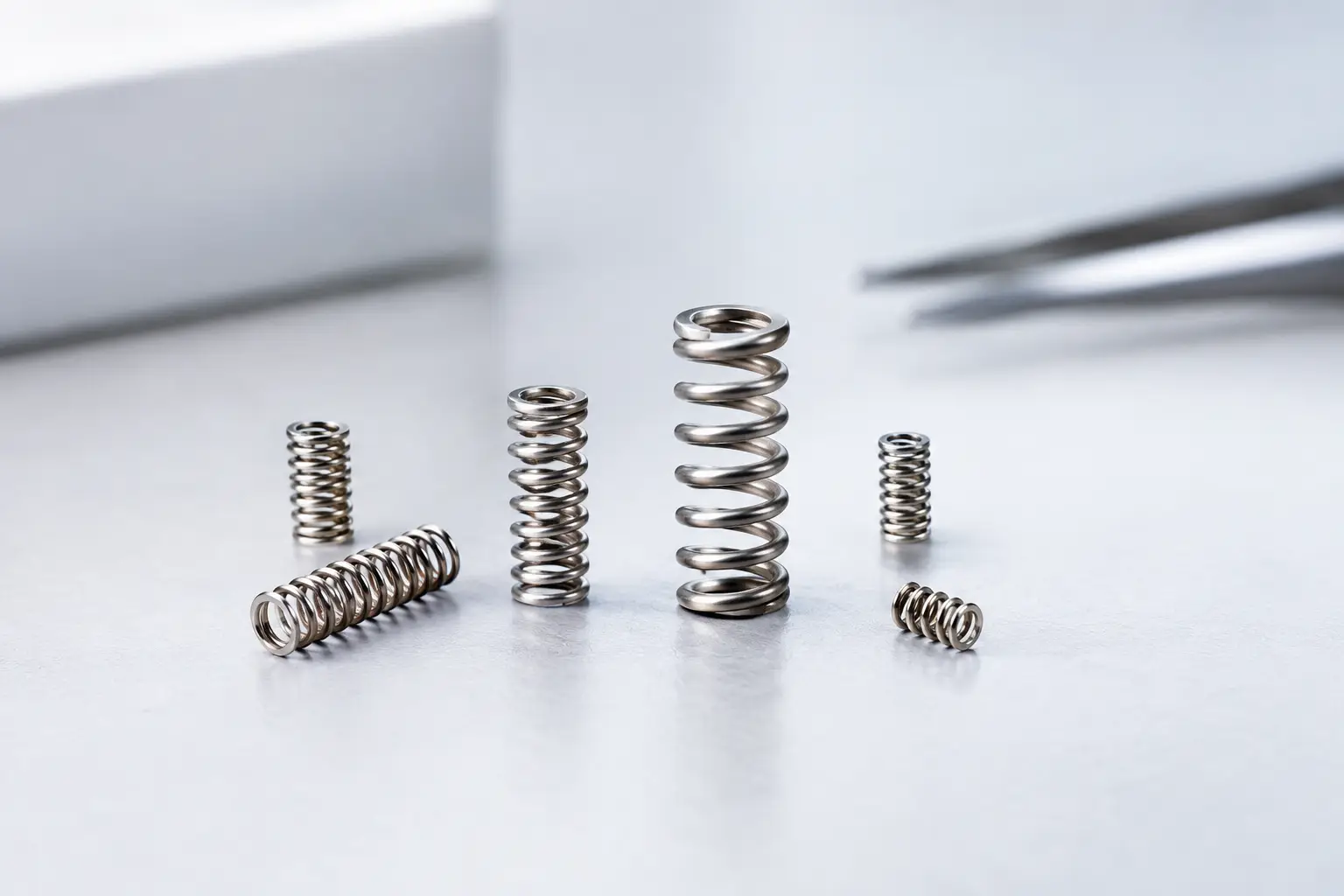
A spring only 2 mm long can decide whether a sensor makes repeatable contact, whether a medical device returns correctly, or whether a precision mechanism survives its intended service life. That is why micro compression springs cannot be treated as simply scaled-down catalogue parts. At this size, a few microns of variation in wire, coil geometry or free length can materially change load, travel and assembly behaviour.
For design engineers, buyers and production teams, the challenge is not merely finding a supplier able to wind fine wire. It is defining a spring that can be measured, manufactured and repeated at volume. Small parts. Big consequences.
Why micro compression springs behave differently
A compression spring stores energy as it is shortened and returns that energy as the load is released. The basic principle is familiar. The practical behaviour of a micro spring is less forgiving.
As wire diameter falls, the influence of material variation, surface condition and forming consistency rises. The spring rate is strongly affected by wire diameter, mean coil diameter and active coil count. A very small change in any one of these variables can shift the force beyond what a sensitive mechanism will accept. When a spring operates beside miniature contacts, MEMS-related assemblies, micro valves or compact optical hardware, that shift may be enough to affect signal quality, sealing force or positional accuracy.
Handling introduces another consideration. A spring that performs correctly in a test fixture may tangle, buckle or seat inconsistently in an automated assembly process. The component must therefore be designed for the complete system, not only for a nominal force figure on a drawing.
Start with function, not a familiar dimension
The most useful spring specification begins at the working points. Rather than requesting a particular free length because it resembles an existing part, define the force required at the installed height and at the maximum operating deflection. This gives the spring manufacturer the information needed to select viable geometry.
For each load point, identify the allowable force range rather than a single ideal value. Also state the expected travel, whether the spring is preloaded, and whether it will approach solid height in normal use. A spring compressed close to solid may be compact, but it carries a higher risk of permanent set and early fatigue. Sometimes a marginally longer spring with a more comfortable working range is the better engineering choice.
The available envelope matters just as much. Specify maximum outside diameter, minimum inside diameter where the spring runs over a guide pin, and any restrictions imposed by a bore or retaining feature. If the spring is unsupported, assess buckling. Long, narrow compression springs can bend sideways rather than compress axially, especially when installation alignment is not controlled.
End configuration should not be an afterthought. Closed or ground ends can improve seating and load transfer, but may not be necessary for every miniature application. The right decision depends on the required stability, force tolerance, available space and production volume. Adding a demanding end requirement without a functional reason can increase cost and lead time.
Tolerance is a system decision
Tightest tolerances should be reserved for characteristics that genuinely govern function. A drawing that applies restrictive limits to free length, coil diameter, wire diameter and force at several heights may appear thorough, yet it can make an otherwise practical part unnecessarily difficult to produce.
Consider the tolerance chain around the spring. If a housing depth varies by 0.05 mm, a spring free-length tolerance of a few microns may deliver no real benefit. Conversely, if contact force must remain within a narrow window for electrical performance, the force at installed height should be the controlled feature, supported by dimensions that are realistic for the manufacturing process.
A good technical review separates critical-to-function requirements from reference dimensions. It also agrees how force is tested: at which heights, with which fixture arrangement and after what conditioning. Without this clarity, two parties can measure the same spring correctly and still obtain different results.
Material selection is about the operating environment
Stainless spring steels are widely used because they combine corrosion resistance with useful mechanical properties. They are not automatically the answer. Temperature, humidity, chemical exposure, electrical requirements, magnetic sensitivity and cleaning processes can all influence material selection.
For example, a medical or laboratory device may require compatibility with cleaning agents or controlled environments. An automotive sensor may face thermal cycling, vibration and moisture. Semiconductor or optical equipment may require careful attention to cleanliness, particulate generation and magnetic behaviour. In a high-temperature application, relaxation resistance may be more significant than initial spring rate.
Surface condition deserves equal attention. Fine wire is vulnerable to scratches and handling damage that can become fatigue initiation points. Coatings, passivation or specialised finishes can help in the right application, but each introduces questions around thickness, friction, adhesion and dimensional impact. The smallest coating change can matter when clearances are measured in hundredths of a millimetre.
Design for fatigue, set and real assembly
A micro compression spring should be assessed against its full duty cycle, not just its first compression. If it will operate repeatedly, define the expected number of cycles, minimum and maximum working heights, speed of actuation and any vibration. These details allow the spring to be designed away from damaging stress levels where possible.
Permanent set is another common source of trouble. A newly formed spring can lose some free length after initial loading as residual stresses settle. Presetting or other process controls may be used to improve stability, but the appropriate approach depends on the material, geometry and force range. The key is to distinguish between an acceptable conditioned change and a drift that compromises system performance.
Assembly conditions can be equally decisive. Does a pick-and-place system need a closed, stable spring? Will the component be inserted over a pin, into a pocket or through a tube? Is there a risk of nesting during bulk handling? A spring that is technically correct but unreliable to feed can create far greater cost than its purchase price suggests.
Turning a sketch into a producible spring
Early involvement with a micro-spring specialist saves time because manufacturability choices are often hidden in the first concept. The initial discussion should cover the application, envelope, required loads, travel, material constraints, annual volume, test method and assembly route. A clear drawing remains essential, but it is not the entire specification.
Prototype quantities are valuable when they are used to test the mechanism rather than merely confirm that the spring fits. Measure actual load at working height, inspect how the spring seats, and run enough cycles to reveal set, wear or positional problems. Where performance is critical, correlate the spring test fixture with the customer’s assembly so that results translate into production.
Production readiness also requires a practical inspection plan. Force testing may be more meaningful than checking every geometric feature, while free length, outside diameter and visual condition may provide useful process control. The correct balance depends on risk. A disposable low-load product and a safety-relevant actuator should not carry the same validation burden.
A local technical partner reduces unnecessary loops
Micro compression springs sit at the intersection of design, materials science, forming capability and quality assurance. Managing those disciplines across several specialist suppliers can slow a programme, particularly when a design change affects tolerances, tooling, inspection and delivery planning at once.
JVS Sales & Technical Consultants GmbH helps product teams coordinate that conversation with specialist manufacturing partners from the first sketch through to production-ready components. The value is not simply access to a niche process. It is having a technically fluent local contact who can challenge a specification constructively, clarify what must be controlled and keep the project moving when details change.
The best micro compression spring is rarely the one with the most demanding drawing. It is the one whose force, geometry, material and inspection method are aligned with the job it has to do – reliably, repeatedly and without making production harder than it needs to be.
